
Gloria Steinem and abortion: An ongoing fight
The legacy left by journalist Gloria Steinem, one of the leading figures of the American feminist movement, is back in the spotlight, particularly regarding the right to abortion. Steinem’s fight, which broke the silence on this issue 50 years ago, continues today in both the US and Turkey

10.09.2026
Journalist and activist Gloria Steinem, one of the most prominent figures in the American feminist movement, passed away on 2 September at the age of 92. Following the news of her death, the American media – particularly female journalists and figures from within the feminist movement – paid tribute to her legacy one after another: some highlighted her activism spanning over 60 years; others emphasized the platform she established with Ms. Magazine, considered one of America’s pioneering feminist publications; whilst others underscored her symbolic role in the fight for women to have a voice in the public sphere.
There is a detail that makes this name feel not so distant to me, but a little closer: an investigative report I co-authored with a colleague last year was published in Ms. Magazine. It was Steinem’s name that came to my attention whilst researching the magazine’s history prior to publication. Although I had never met her, as a journalist from Turkey, being featured in a publication founded by one of the founding figures of the American feminist movement made me realize just how vibrant and international her legacy still is.
But there is a common thread running through most of these tributes: when we speak of Steinem’s legacy, we are actually speaking of a fight that is far from over. For in her lifetime, she witnessed both the constitutional enshrinement of the right to abortion and the subsequent stripping away of that protection.
Her own experience lay at the heart of this fight: in 1957, when she was just 22, her journey to India took her via England — there, whilst abortion was still illegal, she had an abortion with the help of a doctor. She did not tell anyone about this for years.
In 1969, when she heard women sharing their own abortion experiences publicly for the first time at a church meeting in New York, something changed.
Steinem would later describe this moment as follows: “For the first time in my life, I saw women standing up and telling the truth about something that was not supposed to be discussed in public.” Her own experience now made sense — and this marked the turning point when she moved from writing to street activism.
In 1972, when abortion was still a criminal offense in most states across the country, Steinem published a manifesto titled “We’ve Had Abortions” in the first issue of Ms. Magazine, which she had founded, alongside 53 other prominent women. The aim was simple: to show everyone that making abortion illegal did not deter women from having one, but merely forced them to undergo the procedure in secret and under unsafe conditions. This manifesto was one of the first major steps in taking abortion out of the realm of private matters and turning it into a public debate.
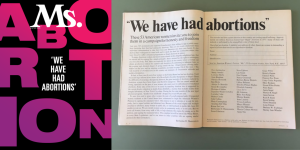
From the cover and an inside page of the Spring 1972 issue of Ms. Magazine: the “We’ve Had Abortions” manifesto, published with the signatures of 53 women. This manifesto was one of the first major steps in shifting abortion from a matter of privacy to a public debate. Archive: Ms. Magazine
This fight, which began with a statement 50 years ago, is still asking the same question today: Who has the final say over a woman’s body?
The answer changed in 2022. With the “Dobbs v. Jackson Women’s Health Organization” ruling — commonly known as the Dobbs ruling — in which the US Supreme Court overturned the Roe v. Wade decision that had guaranteed abortion as a constitutional right since 1973, the authority to regulate abortion passed entirely to the states.
The current situation is as follows: abortion is completely banned in 13 states — in some of these, there are not even exceptions for rape, incest or fatal abnormalities. In contrast, there are no gestational week limits in nine states and the District of Columbia. In other words, the country is effectively split in two when it comes to access to abortion — whether a woman can exercise this right no longer depends on her beliefs or her decision, but on the state she lives in.
The consequences of this division are not abstract, but very real: according to a study by Planned Parenthood, in just one year, 43,830 people in states with total bans were unable to access abortion services within their own state. Some were able to travel to neighboring states; others were not. That old reality from 1972, when abortions were performed in secret and under unsafe conditions, has returned 50 years later in a different guise: abortion is no longer illegal, but for some, it remains out of reach.
This situation is not unfamiliar to us. In Turkey, abortion has been legal since 1983 — up to 10 weeks, provided it is carried out in a hospital. But “being legal” and “being accessible” are not the same thing here either. The refusal to provide abortion services in public hospitals on grounds of conscientious objection, coupled with the fact that in some provinces it has become almost impossible to find a doctor offering this service, is forcing women either to pay high fees at private healthcare facilities or to be unable to access the service at all. In other words, the situation described by Steinem in the US, where conditions vary from state to state, is being experienced in Turkey from province to province, and even from hospital to hospital — all whilst the law remains unchanged.
The picture in the media is no different. According to a study by NewsLabTurkey analyzing 12 news sites in Turkey, amongst stories on sexual and reproductive health, the topic of abortion accounts for just 1.3 per cent of coverage — far behind issues such as infertility or sexual dysfunction. The silence that Steinem sought to break 50 years ago in the US persists here: abortion is neither discussed sufficiently in news bulletins nor does it find a space where women can share their own experiences.
But like any legacy, Steinem’s was not left unquestioned. One of the criticisms that resurfaced following her death was that she had worked for a cultural organization funded by the CIA between 1958 and 1962 — a detail that, for a time, was shared on social media as if it were the “real truth,” presented almost as a new discovery.
Yet this connection was never a secret; Steinem spoke about it openly on numerous occasions. The real question is not whether this detail exists, but where it fits within the broader context of her life. For this period pertains to a Steinem who was still only 24–28 years old and not yet part of the feminist movement. The activism for which we remember her today — 1969, when she made sense of her experience in London; 1972, when she published the “We’ve Had an Abortion” manifesto; and her fight spanning more than 50 years — only took shape years after this period. Therefore, selecting a single detail from a public life spanning over 60 years — one that predates her feminist career — and placing it at the forefront of her legacy cannot be considered a chronologically fair interpretation.
Moreover, those who first raised this criticism did not come from outside the movement, but from within it — the primary concern of the radical feminist collective known as the Redstockings, who investigated Steinem’s CIA links in the 1970s and brought them to public attention, was not to discredit her, but to question the direction in which the movement was being steered. In other words, even this debate was, in fact, a product of a sense of ownership towards the feminist movement.
Perhaps the question we should be asking today when we remember Steinem is not whether she was flawless. Fifty years ago, even for a woman to say “I have had an abortion” was an act of courage; the fact that we still have to say it with the same courage today shows just how unfinished the legacy she left us really is. The courage to break that silence that Steinem pioneered is a call not just to America, but to women everywhere where abortion is still a source of shame, a crime or a matter for negotiation: this is not a fight that can be won by remaining silent.